News and Features


The Dictionary Unit for South African English (DSAE) is a non-profit organisation based in Makhanda (formerly Grahamstown), South Africa. Its dictionary project was established in 1969. Recent digital content and activities, as well as archival material, are featured below.

For press information please email dsae@ru.ac.za.


Dictionary releases

revised edition image

2025 Revised Edition

In March 2025 DSAE published a revised online edition of its open-access historical dictionary of the South African variety of English. This edition, two years in the making, features an updated visual design for both Mobile and Desktop platforms and introduces the new dictionary logo featuring the protea, South Africa’s iconic national flower.

A major content update in this edition is the new audio pronunciation feature. While the dictionary retains phonetic transcriptions, you can now click to play over 3900 recordings of South African English words including alternative pronunciations. These studio recordings, created using authentic South African English speakers, represent an unparalleled phonetic dataset available for the first time.

Aside from changes to existing entries, over 100 new words have been added across a range of domains, including: Sport (shibobo, diski), Law (Aquilian liability), Music (amahubo, boereqanga), Politics and History (the struggle, struggle credentials), Food and Drink (magwinya, walkie talkies, papsak) and Cultural terms (boerewors curtain). Words reflecting everyday life in South Africa have also been added to the dictionary’s three centuries of regional usage (load shedding, mjondolo, ekasi), plus historically recent colloquialisms such as fong kong, makoya, eish, and tsek.

Corrected edition image

DSAE Corrected Edition

Following a design phase which transformed a compressed printed dictionary text into a layered, graphical Web Application for multiple platforms, the Corrected Edition was published in March 2023. Design and usability imperatives having been met, the current edition introduces content updates across a 1.5-million-word dictionary text.

Terms originally flagged as unassimilated into South African English (igqira, tata) now reflect as current usage based on updated linguistic evidence. Language names which had changed in the post-democracy officialisation of South African languages (Zulu to IsiZulu, Tswana to Setswana) now display as such.

In addition to updates to pronunciations, place names across the dictionary now reflect official names disseminated by the South African Geographical Names Council, e.g. Makhanda (formerly Grahamstown, Eastern Cape, South Africa), the home of the Dictionary of South African English.
Visual dictionary image

DSAE Visual Edition

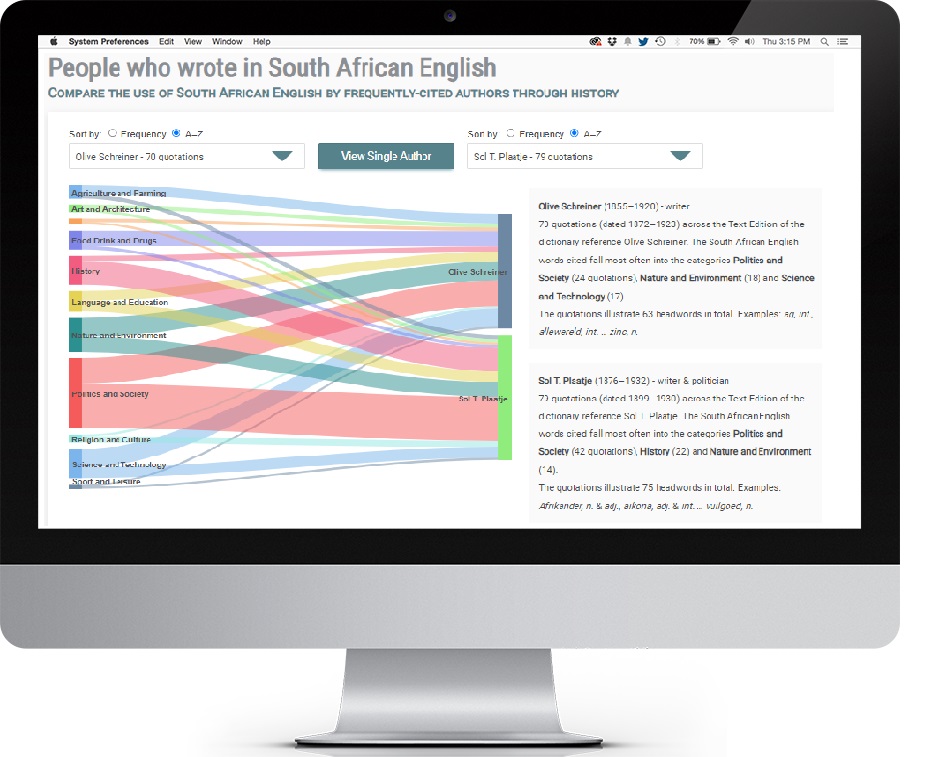
To make the unparalleled textual coverage of South African English documented in the online dictionary accessible in graphical form, leveraging new data visualisation and data aggregation techniques, the DSAE published a parallel Visual Edition in March 2022. This dictionary gives full textual histories of 4600 South African English words including compounds, derivatives and evidential quotations, resulting in a total of 1.5 million words of running text.

The DSAE Visual Edition offers new insights into the evolution of South African English from its earliest sources in the late 1600s, before the concept of “South Africa” as a country existed. The dictionary is rendered visually through macro- and micro-visualisations including graphical overviews, visual navigation (via Language of Origin, Register, Part-of-Speech and Subject Category), plus infographics comparing the contributions of prominent authors to the documentation of South African English. Access the Visual Edition at visual.dsae.co.za.
Mobile phone image

DSAE Mobile Edition

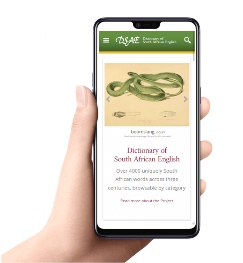
The release of the Mobile Edition of the online Dictionary of South African English in March 2020 marked the completion of a major digitisation phase from early pilot online editions to a fully-fledged web application thoroughly adapted for Desktop and Mobile devices. The same advanced feature set is now available on both platforms, preserving advanced Desktop features and user experience that rescale seamlessly on Android and iOS.

The Desktop Edition’s mascot entry was aardvark, the proverbial first word in the English dictionary for this “ungainly”, “sticky-tongued” species of anteater. The 2020 Mobile Edition paid tribute to its threatened evolutionary cousin, the scaly anteater or pangolin.

Read the Rhodes University press release here.

Desktop edition image

DSAE Desktop Edition

The DSAE’s dictionary publishing goal for 2019 was the completion of its major re-design of the online Dictionary of South African English, originally released as a pilot edition with a user interface strongly reminiscent of the print edition. Given the complexity of the historical dictionary model, numerous design and navigation challenges had to be resolved in the dictionary. Additionally, new types of features such as micro-visualisations were added to the dictionary interface to relieve users of the cognitive burden of text-heavy entries. By far the most powerful new feature was category-based dictionary filtering, allowing the user to view subsets or slices of the dictionary based on criteria such as Subject Category, Register, or Language of Origin. A beta version of the dictionary was released in November 2018 and the full version, which included full-text search functionality among other added features, was published on 25 March 2019.


Recent conferences and symposiums

Dictionary Day poster image

Dictionary Day 2022

Click here to view the DSAE video presentation at Dictionary Day 2022, hosted by the Pan South African Language Board (PanSALB) and the South African National Lexicography Units.

Afrilex logo

AFRILEX Conference 2022

The 26th International Conference of the African Association for Lexicography (AFRILEX) was held at Stellenbosch University from 27 - 29 June 2022. In 2022 Mr Tim van Niekerk, Executive Director of the Dictionary Unit for South African English, was invited to present the pre-conference workshop. His presentation A short, sharp introduction to the creation and presentation of online dictionaries outlined the digital adaptation of the DSAE’s flagship historical dictionary, a project that required editor-defined, machine-readable data modelling as a foundation for the development of an enhanced dictionary architecture and, superimposed on this, a modern user interface design.

Oxford University Press logo

World English Symposium 2022

Executive Director for the Dictionary Unit for South African English, Mr Tim van Niekerk, was invited to act as a panelist at the Oxford World English Symposium 2022. The symposium, hosted by Oxford University Press, aimed to bring together academic researchers, teachers, lexicographers, and other language practitioners to share research findings, experiences, and insights on World Englishes, in order to come up with innovative approaches to the creation of dictionaries and other lexical resources.

EMLex logo

EMLex 2022

DSAE Senior Editor, Ms Bridgitte Le Du, presented a guest lecture at the European Master in Lexicography (EMLex) Summer School. EMLex is an international Master's degree program that can be concluded with an Erasmus Mundus Joint Master's degree. The title of her presentation was, The application of User Experience (UX) design to online lexicography: some guiding principles from the digitisation of the Dictionary of South African English on Historical Principles.

Dictionary Day poster

Dictionary Day 2021

Click here to view the DSAE video presentation at Dictionary Day 2022, hosted by the Pan South African Language Board (PanSALB) and the South African National Lexicography Units.


Projects and events

Image of the print edition

From Aardvark to Zol


Exactly thirty years ago, in the early days of South Africa’s democracy, a remarkable book arrived on library desks across the country. Produced by the Dictionary Unit for South African English (DSAE) at Rhodes University and published by Oxford University Press, A Dictionary of South African English on Historical Principles was imposing in size and scholarly precision, yet it carried an unexpected emotional charge. At a moment when the nation was beginning to narrate itself anew, this dictionary offered a quietly powerful mirror: a record of how South Africans had spoken, written and imagined their world across more than three centuries.

The dictionary did not present South African English as a tidy list of meanings. Instead, it traced words from their earliest known appearance in written sources, drawing on evidence from newspapers, travellers’ journals, court transcripts, literature and everyday documents. This “historical principles” approach demanded forensic rigour. Each word’s story had to be proven through dated quotations that showed how meanings shifted over time. What emerged was not just a reference work but a biography of a people.

Read the full article: From Aardvark to Zol: How documenting language has helped South Africa understand itself published by Rhodes University (4 March 2026).

Image credit: Ntomb’Zekhethelo Ncanana

Makhanda Education Matters front page

DSAE unveils transformed digital resource

From the article Dictionary Unit for South African English unveils transformed digital resource published in the Makhanda Education Matters newsletter Vol. 7 (November 2025): The Dictionary Unit for South African English (DSAE) has announced the recent launch of a revised edition of its acclaimed online Dictionary of South African English. This comprehensive update, two years in the making, introduces new content and features designed to enhance user experience and deepen linguistic understanding. The release of the revised edition on 31 March 2025 solidifies the dictionary’s relevance in the digital age, both locally and internationally in contexts of education, research and scholarship.

The DSAE continues to serve as a vital source of information on South African English for researchers and the public, participating in conferences and contributing to academic journals, reinforcing its role as a cornerstone of linguistic scholarship in South Africa. Today, the DSAE remains a vibrant centre of research, ensuring that the dynamic and ever-evolving nature of South African English is meticulously documented and celebrated for generations to come.

Read the full article: Dictionary Unit for South African English unveils transformed digital resource in Makhanda Education Matters, Vol.7, a publication of the Rhodes University Faculty of Education and funded by the Rhodes Univesity Vice Chancellor’s Office.

DSAE publishes 2025 Revised Edition

From the article DSAE publishes 2025 Revised Edition published by Rhodes University Library (12 September 2025): In March this year the Dictionary Unit for South African English (DSAE), housed in the historic St Peter’s Building on the Rhodes University campus, released the 2025 Revised Edition of its open-access online Dictionary of South African English. This significant milestone for the Unit includes the addition of over 100 new words from a range of subject domains such as Sport (shibobo, diski), Law (Aquilian liability, cession), Music (boereqanga, amahubo), Politics and History (the struggle, struggle credentials), Food and Drink (chakalaka, walkie talkies, papsak), Cultural terms (ekasi, boerewors curtain, after tears) as well as words found in everyday usage (load shedding, fong kong, makoya, eish, tsek). This edition also introduces an exciting new feature, namely audio pronunciations for over three thousand entries, drawn from the Unit’s unparalleled phonetic dataset of authentic audio recordings of South African English words, providing multiple variant pronunciations that supplement the original phonetic transcriptions.

Read the full article: Dictionary of South Africa English publishes 2025 Revised Edition published by Rhodes University Library (12 September 2025).

audio icon image

Audio Pronunciation Project


The Dictionary Unit for South African English embarked on an Audio Pronunciation Project to capture audio recordings for the approximately 4600 entries in the online dictionary, including their variant pronunciations. This amounted to approximately 13 000 audio files recorded by authentic South African speakers reflecting the diverse origins of SAE. The project was made possible by funding from the Pan South African Language Board (PanSALB).

Listen to sample audio clips for:
aardvark
bokbaai vygie
goggatjie
mashonisa

Sadilar promotional image

South African English With a Little Indigenous Spice

The South African Centre for Digital Language Resources (SADiLaR) and the Dictionary Unit for South African English (DSAE) came together to showcase the influence of indigenous South African languages on the regional variety of English.

Visit SADiLaR’s celebration of South African English With a Little Indigenous Spice for a quirky series of video clips highlighting local English borrowings from our 10 other official languages. From isiZulu to siSwati and gatvol to toyi-toyi (both words entering South African English in the 1980s), SADiLaR generously illustrates our country’s zesty linguistic usage and its multilingual influences.

Sunday Argus newspaper image

Sunday Argus Feature

If you’ve never thought of reading a dictionary, a brief browse of the treasure trove at dsae.co.za could change your mind, writes Michael Morris.

There is little to suggest a rational association between “aardvark” and “zef” – an animal and a counter-cultural movement – except perhaps their being distinctly South African terms. But the words have an extra A–to–Z meaning for a small team of language specialists at work on one of the country’s most comprehensive and fascinating cultural projects at Rhodes University's St Peter’s Building . . . Read the full article, SA English as you have never seen it (published in the Sunday Argus, March 05, 2017).


Language features

Heritage Day

The names given to 24 September in South Africa draw together references to events, personages and cultural practices across a wide historical and political spectrum.

The origins of the current official name for 24 September are rooted in the Province of KwaZulu-Natal, specifically the former apartheid-era homeland of KwaZulu, where it was first celebrated as Shaka Day (earliest citation 1973) in honour of the Zulu king, Shaka kaSenzangakhona (‘son of Senzangakhona’). This is a rare instance of an eponymous commemorative day in South Africa.

In 1994 – one and a half centuries after King Shaka’s death – the country’s post-apartheid government designated 24 September as a day of shared national identity, and Shaka Day became known as Heritage Day. Notably, none of the public holidays declared in 1994 are named after people.

The most recent, informal name for this calendar date was coined in the 2000s, namely Braai Day (cf. braai, verb, first recorded in 1891). Although this new designation for Heritage Day was not met with unanimous approval, it appears with high frequency in South African English corpus sources. The earliest available record of its use in writing is attributed to the late Archbishop Emeritus Desmond Tutu, also credited with coining the term rainbow nation.

Women’s Month

Women’s Day, prompting Women’s Month, existed in South African English parlance decades before its official promulgation as a national holiday. The origins of the word (first citation, 1968) are rooted as much in anti-apartheid resistance as in gender activism.

Referencing the historic Women’s March to the Union Buildings, Pretoria on 9 August 1956, it was called South African Women’s Day initially to distinguish it from International Women’s Day. Though the march was not an exclusively ANC event, it is sometimes referred to as ANC Women’s Day in early sources, reflecting its strong association with the liberation struggle at the time (see the struggle, pass laws).

Cherryl Walker (Women and Resistance in South Africa, 1991) described the day: “Many of the African women wore traditional dress, others wore the Congress colours, green, black and gold; Indian women were clothed in white saris. Many women had babies on their backs…” (see abba, black, green and gold, Congress).

Only in the Public Holidays Act No. 36 of 1994, signed by Nelson Mandela in the first year of his presidency, was the day elevated to the status of a national holiday and officially designated National Women’s Day.

Words for Small Things

The South African English word smallanyana was first recorded in 2016 in a New York interview with the former South African Minister of Social Development, Bathabile Dlamini. In the interview she famously suggested that many politicians had “smallanyana skeletons” in their closets. In late 2022 the word resurfaced in popular media in the context of allegations of state corruption. The adjective combines English small and the diminutive suffix -nyana (‘little’, ‘a small portion of something’), producing the meaning ‘a tiny little’ (skeleton). The suffix -nyana was first recorded in the Dictionary of South African English in 1968 under the word nipinyana, denoting a small measure or ‘nip’ of an alcoholic beverage, a term which is still current in South African English.

In similarly informal contexts, some South Africans playfully use the diminutive connotations of nyana as a noun to downplay a perceived vice, e.g. “two nyana” meaning two alcoholic drinks. Others attempt no mitigation of their consumption and refer to their tipple simply as a dop (see sense 3).

Lockdown Lingo

A televised address on 29 April 2020 saw the DSAE’s then first recorded use of the word zol as a verb, when South African Minister Dr Nkosazana Dlamini-Zuma curbed the enthusiasm of “those who zol” (smoke hand-rolled cigarettes) by announcing the extension of a temporary ban on tobacco products.

The minister’s statement was lampooned in David Scott’s parody of the South African national anthem, which in turn revived several slang terms for cigarettes and tobacco, such as entjie, skyf and gwaai. Dagga – one of the oldest South African English words, dating back to 1670 – also received honourable mention.

For related words, see the dictionary’s list of terms for Smoking and Drug Use.

Afrikaans

Afrikaans gave English the word trek, first used in South African English in the 1800s and later assimilated into general English (think Star Trek). Afrikaans borrowings are used by South Africans daily to refer to phenomena from landscapes (kloof) to foods (perlemoen), social relationships (boet, bad friends) and even to entertainment genres (skop, skiet en donder).

See numerous South African English words derived from Afrikaans, recorded from the 17th century onwards.

IsiNdebele

IsiNdebele is an Nguni language with over a million mother-tongue speakers in South Africa (Census 2011), concentrated in the northeastern region of the country. South African English words borrowed from isiNdebele include mobola plum (also known as the hissing tree), and toyi-toyi, the iconic militaristic dance step used in protest action from the late 20th century onwards.

Read more about these and other South African English words derived from isiNdebele.

Setswana

Setswana has prompted numerous South African English words for a range of contexts from social interaction to the natural environment. First impacting on English in the early 1800s by providing terms for local fauna (tsessebe), Setswana borrowings later enacted daily social interactions (dumela) or described community events (lekgotla) and culinary items (morogo).

See numerous South African English words derived from Setswana, recorded from the 17th century onwards.

Xitsonga

Xitsonga (part of the Bantu language family) is spoken as a first language by over 2 million South Africans (Census 2011). Prominent Xitsonga speakers include former South African soccer star, Jomo Sono, the current mayor of Johannesburg, Herman Mashaba, and the South African Finance Minister, Tito Mboweni. According to available linguistic evidence, the word Tsonga as a name for the people (now Vatsonga), entered South African English in 1940. Other borrowings from Xitsonga include focho (a music style) and nyala (a species of antelope).

Sesotho sa Leboa

Sesotho sa Leboa is a Northern Sotho language spoken by the Basotho people of Limpopo Province in South Africa. The South African English words marula (a species of tree or its edible fruit) and Modjadji (or Rain Queen of the Lobedu people) are loan words borrowed from this language.

See more South African English words derived from Sesotho and Sesotho sa Leboa, first recorded from the early 19th century onwards.

Sesotho

Did you know that several South African English words such as lapa (an enclosure for outdoor entertainment purposes) and lekgotla or kgotla (a council or public meeting) are loan words borrowed from Sesotho?

See more South African English words derived from Sesotho and Sesotho sa Leboa, first recorded from the early 19th century onwards.

Tshivenda

The Tshivenda language has over 1.2 million speakers in South Africa (Census 2011), mainly among the Venda people in Limpopo Province. Some South African English words derived from Tshivenda include: mopani (a species of tree) and the mopani worm that it hosts; malombo (a style of music influenced by the traditional ceremony of the same name); and terms for musical instruments such as the mbila (a type of xylophone) and murumba (a small drum).

See more South African English words derived from Tshivenda, first recorded from the early 19th century onwards.

IsiXhosa

IsiXhosa is the second most commonly spoken indigenous language in South Africa (Census 2011). Did you know that typical South African English words such as fundi (an expert or enthusiast), kwela (a distinct style of music and dance) and ubuntu (human-heartedness or compassion) are borrowed from isiXhosa?

Discover more South African English words derived from isiXhosa, first recorded from the early 19th century onwards.

SiSwati

SiSwati is spoken by 1.3 million South Africans (Census 2011) and is mainly used in the province of Mpumalanga, an area bordering the Kingdom of eSwatini (formerly Swaziland). Perhaps the best known Swazi cultural event is the annual reed-dance during which unmarried women pay homage to the Ngonyama (a hereditary title of Swazi kings) and Ndlovukazi (an honorific title given to the Queen Mother).

Read more about these and other South African English words derived from siSwati.